3 posts tagged with "open-source"

View All Tags

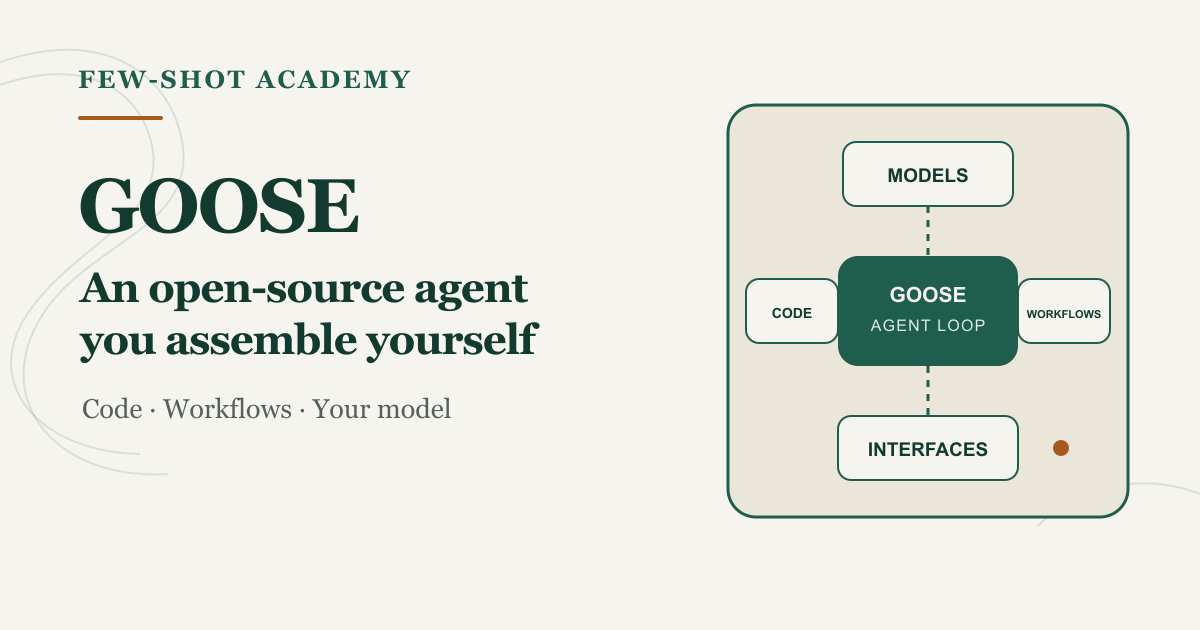
Goose: An Open-Source Agent You Can Assemble Yourself

· 11 min read
Mangat Rai
Creator, Few-Shot Academy

A few days ago, I wrote about AGENTS.md, the file that gives coding agents project-specific instructions. While reading through the Linux Foundation's Agentic AI Foundation site, I came across another founding project: Goose.

The pitch caught my attention. Goose runs on your machine, lets you choose the model, and connects to tools through the Model Context Protocol.

However, The five-minute quickstart says Goose improves software development by automating coding tasks. The tutorial asks it to build a JavaScript game. The Goose homepage, however, calls it a general-purpose agent for research, writing, automation, data analysis, and code.

What was I looking at? Is it a coding agent or a general-purpose agent?

What i figured at the end is that Goose is both, but not equally. Coding is the go to path. Its extension system lets you give the same agent a different set of tools and a different job.

AGENTS.md: one guide for your coding agents

· 10 min read
Mangat Rai
Creator, Few-Shot Academy

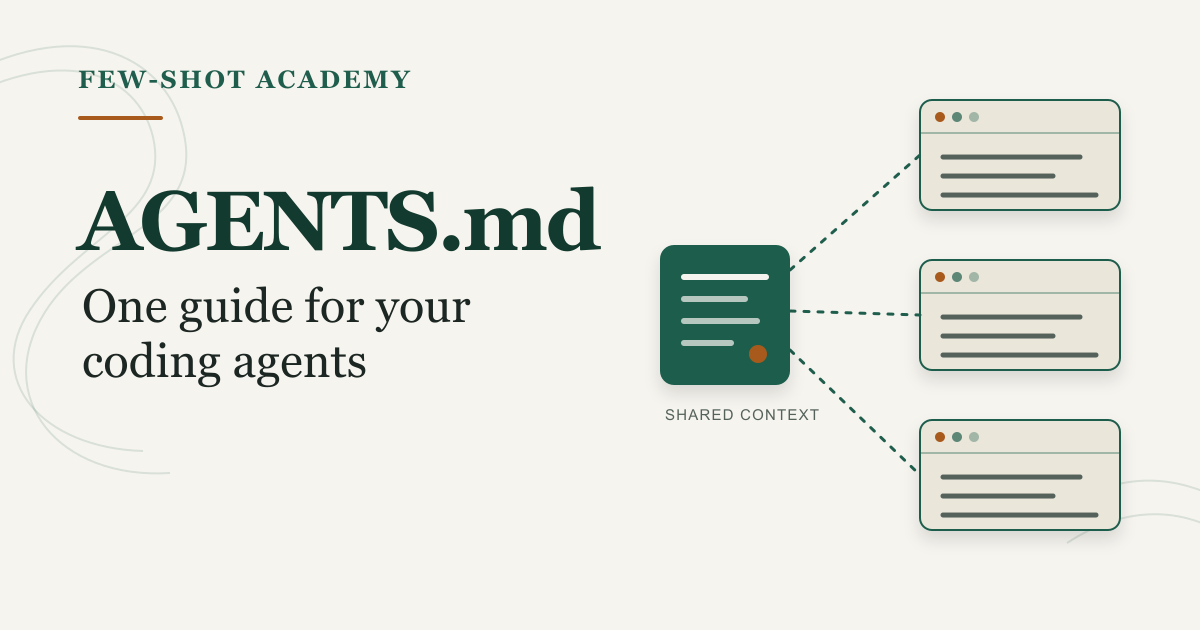
AGENTS.md is a Markdown file you keep in your repository to tell coding agents how to work on the project. It can explain where the code lives, which commands to run, and which decisions the agent should leave to you. The open format has no required fields or schema.

Imagine asking an agent to add a page on Monday. You explain the project's colors, where the source lives, and why the navigation must stay as it is. On Friday, a contributor picks up the work in another coding tool. Their agent proposes a new color scheme and reorganizes the navigation. The decisions are still in Monday's conversation, but they never made it into the repository.

That is the gap this file is meant to close. Write the ground rules down once, keep them with the code, and give the next agent a place to start.

Every major AI lab shipped an agent model this week

· 8 min read
Mangat Rai
Creator, Few-Shot Academy

For the last two years, open-weight model releases have mostly been a China story: DeepSeek, Alibaba's Qwen team, Moonshot AI's Kimi, Zhipu's GLM, MiniMax, all shipping frontier-class open weights on a cadence Western labs haven't matched. This week Meta broke that pattern, twice, in one release. It shipped Muse Glimmer, a 30-billion-parameter model with Apache 2.0 weights on Hugging Face, alongside Muse Spark 1.2, a hosted sibling built for long coding sessions. The interesting part isn't that Meta released open weights again. It's that, by Meta's own benchmarks, Glimmer beats two other well-known open-weight models roughly its own size at the kind of multi-step, tool-using tasks that used to separate the labs with the biggest budgets from everyone else.