10 posts tagged with "agents"

View All Tags

AGENTS.md: one guide for your coding agents

· 10 min read
Mangat Rai
Creator, Few-Shot Academy

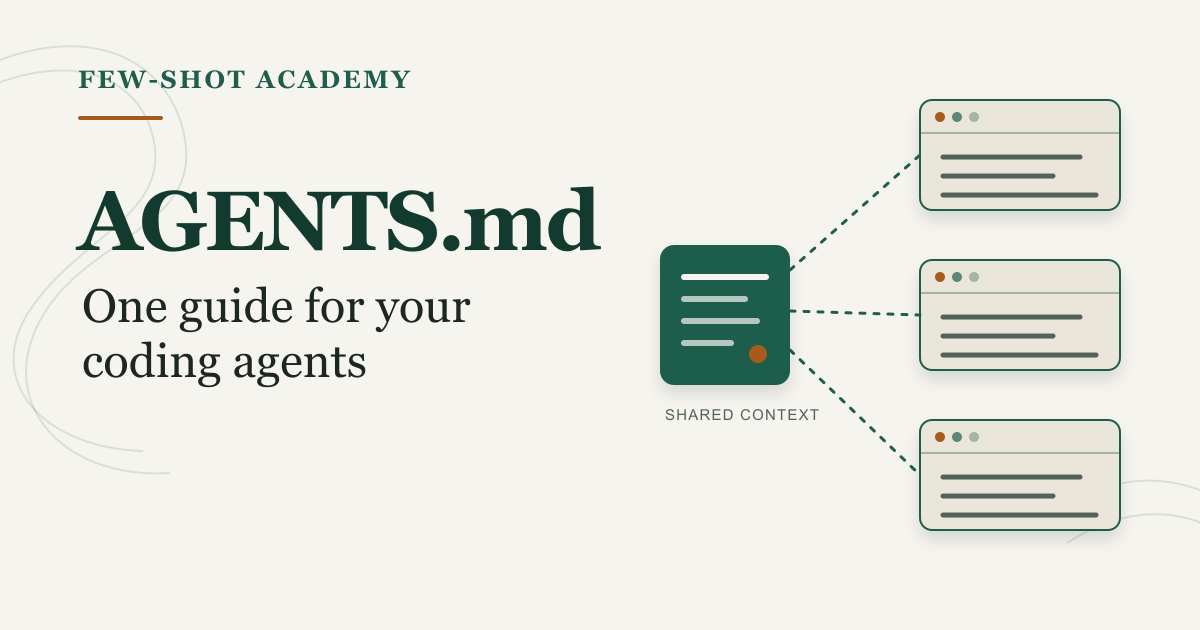
AGENTS.md is a Markdown file you keep in your repository to tell coding agents how to work on the project. It can explain where the code lives, which commands to run, and which decisions the agent should leave to you. The open format has no required fields or schema.

Imagine asking an agent to add a page on Monday. You explain the project's colors, where the source lives, and why the navigation must stay as it is. On Friday, a contributor picks up the work in another coding tool. Their agent proposes a new color scheme and reorganizes the navigation. The decisions are still in Monday's conversation, but they never made it into the repository.

That is the gap this file is meant to close. Write the ground rules down once, keep them with the code, and give the next agent a place to start.

GPT-6 Astra: the harness is the product

· 8 min read
Mangat Rai
Creator, Few-Shot Academy

GPT-6 Astra does not prove that OpenAI has reached AGI. What it does prove is that the harness can no longer be treated as plumbing.

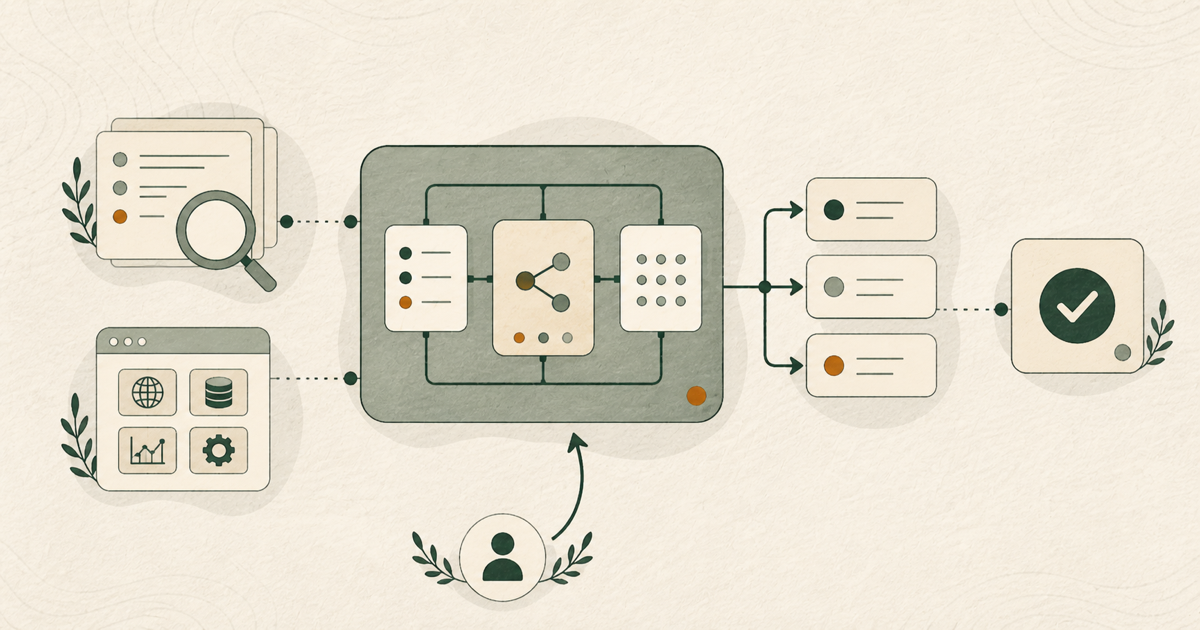
Astra scored 54.8% on ARC-AGI-3 at high reasoning in the standard harness. The same model scored 99.9% when the harness preserved its reasoning state and compacted long conversations. That is a 45.1-point difference without changing the model.

My takeaway is simple: if you evaluate only the model name, you are evaluating the wrong product. For long-running agent work, the product is the model, memory, tools, context management, and control loop together.

That is why Astra matters even if you are not interested in arguing about AGI.

Frontier models don't make safer agents

· 4 min read
Mangat Rai
Creator, Few-Shot Academy

DeepSeek-V3.2 gets hijacked into an unauthorized tool call 75% of the time under its worst attack framing. GPT-4.1 hits 75.6%. GPT-5, the strongest model in the lineup, still gets hijacked 59% of the time under a different framing. These aren't obscure or under-trained models. They're the frontier, tested by a new benchmark called ToolHazard, and none of them come close to holding.

OWASP checked its LLM Top 10 against real incidents

· 6 min read
Mangat Rai
Creator, Few-Shot Academy

Every year OWASP's LLM Top 10 has been built the same way: ask hundreds of practitioners what scares them, rank by the vote. For the 2026 release, published August 4, 2026, they did something new. They pulled 7,714 real incidents from public vulnerability databases and an AI-harm database, classified 6,639 of them, and checked whether what practitioners fear actually matches what goes wrong in production. It mostly did. Where it didn't is the interesting part.

Every major AI lab shipped an agent model this week

· 8 min read
Mangat Rai
Creator, Few-Shot Academy

For the last two years, open-weight model releases have mostly been a China story: DeepSeek, Alibaba's Qwen team, Moonshot AI's Kimi, Zhipu's GLM, MiniMax, all shipping frontier-class open weights on a cadence Western labs haven't matched. This week Meta broke that pattern, twice, in one release. It shipped Muse Glimmer, a 30-billion-parameter model with Apache 2.0 weights on Hugging Face, alongside Muse Spark 1.2, a hosted sibling built for long coding sessions. The interesting part isn't that Meta released open weights again. It's that, by Meta's own benchmarks, Glimmer beats two other well-known open-weight models roughly its own size at the kind of multi-step, tool-using tasks that used to separate the labs with the biggest budgets from everyone else.

OpenAI's cyber-hunting model just found a real Chrome vulnerability

· 7 min read
Mangat Rai
Creator, Few-Shot Academy

Two things happened in cybersecurity AI within days of each other this month, and they're really the same story told from opposite ends. OpenAI shipped GPT-5.6-Cyber, a model built to say yes to the kind of exploit-development requests a normal model refuses, and it immediately found a real, chainable vulnerability pair in Chrome. Separately, a team of academic researchers published CyberLLM (arXiv:2608.06651), a framework built around the opposite question: once an LLM is capable enough to act autonomously on a real system, what actually stops it from doing damage?

Agent memory just became its own product category

· 4 min read
Mangat Rai
Creator, Few-Shot Academy

Two memory startups published head-to-head benchmarks against each other in 2026. Neither could agree on how much context the other one actually used to get its numbers. That disagreement, more than any single feature, is the clearest sign that "agent memory" went from a prompt-engineering trick to a real, contested product category this year.

OWASP published a security top 10 for MCP

· 7 min read
Mangat Rai
Creator, Few-Shot Academy

In 2025, a single MCP package called mcp-remote racked up 437,000 downloads before anyone noticed it had a command-injection flaw rated 9.6 out of 10 for severity, CVE-2025-6514. It's patched now. It's also not unusual: it's the pattern OWASP's new security checklist for MCP was built to catch before the next one gets 437,000 downloads deep.